

New York City Marathon, 2005
I don’t know what it is about long distance running, but it seems to cut a life short. Here’s the post about marathon runners having more arterial plaque than a group of their sedentary, matched peers: Study: Marathon Runners Have More Plaque
And here’s an article from this week. It summarizes a presentation given at the American College of Cardiology’s annual conference on Sunday.
Too Much Running Tied to Shorter Life Span, Kathleen Doheny, HealthDay, 1 April 2014
The presentation was “Are Cardiovascular Risk Factors Responsible for the U-Shaped Relationship between Running and Longevity? The MASTERS Athletic Study,” but I had no luck finding it. (Update: Here it is. Thanks, Shaun.)
From HealthDay:
“Recent research suggests there may a point of diminishing returns with running. … People who get either no exercise or high-mileage runners both tend to have shorter lifespans than moderate runners.”
The researchers looked at data from ~3,800 men and women runners, average age 46. (You can add yourself to this database by filling out the online questionnaire here.)
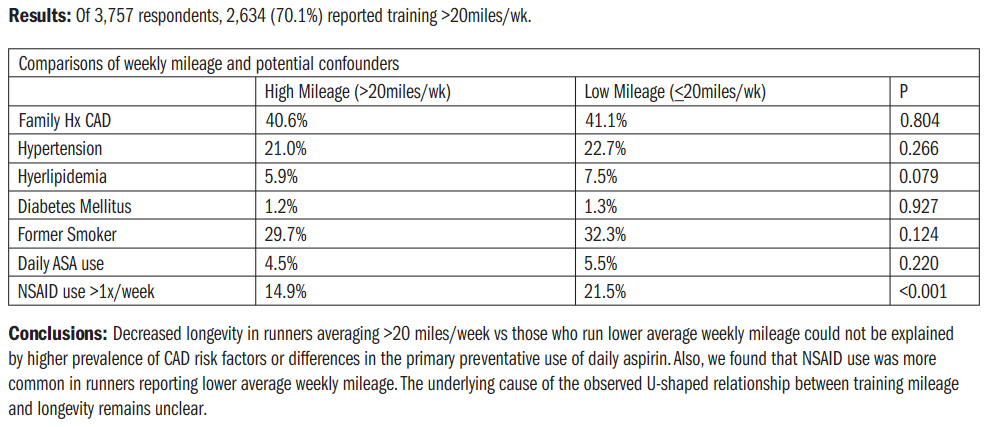
None of the following factors explained the shorter lives of high-mileage runners (more than 20 miles/week):
- Use of NSAIDS (Non-Steroidal Anti-Inflammatory Drugs such as ibuprofen/Advil and naproxen/Aleve)
- Aspirin use
- Blood pressure
- High cholesterol
- Diabetes
- Family history of heart disease
- Smoking history
Here’s their data and conclusion:
Where’s diet? I’d love to see diet’s impact on these numbers.
Dr. James O’Keefe, director of preventive cardiology at the Mid-American Heart Institute in Kansas City (from HealthDay):
“Even though the heart disease risk factors couldn’t explain the shorter longevity of high-mileage runners, there do seem to be potentially life-shortening ill effects from that amount of running.
In O’Keefe’s view, the “sweet spot” for jogging for health benefits is a slow to moderate pace, about two or three times per week, for a total of one to 2.5 hours.
O’Keefe advises runners to avoid strenuous exercise for more than an hour at a time.”
What if, to use him as an example, Jim Fixx quit smoking and took up running at the age of 36, as he did, but just ran about 3 hours a week? No marathons. Would he have lived longer? (Fixx, marathoner and author of the hugely popular The Complete Book of Running (1977), died of a heart attack while running. He was 52.)
 Fanatic Cook