

Beyond Meat’s meatless chicken strips made from soybean and pea proteins.1
The whole class of meat alternatives has taken off, and by the looks of that burger photo at the bottom of this post, has gotten rather sophisticated. Meat substitutes are manufactured from plant molecules and engineered to taste like animal products. The Economist just profiled their rise:
Silicon Valley Gets A Taste For Food, The Economist, 7 March 2015
Why are they taking off? Businesses see a market:
The idea of making such products is attracting entrepreneurs and venture-capital firms who think that the traditional food industry is ripe for disruption because it is inefficient, inhumane. … “Animal farming is absurdly destructive and completely unsustainable. Yet the demand for meat and dairy products is going up,” says Patrick Brown, founder of one such startup, Impossible Foods.
The meats’ developers say their products are healthier than the real thing. I imagine that claim has its detractors.
The companies have different approaches, but they share the ambition of creating new plant-based food that they say will be healthier, cheaper and just as satisfying as meat, egg, dairy and other animal-based products—but with a much lower environmental impact.
Are they healthier than the meats they imitate? I don’t know. But I’ll venture they’re not healthier than the plants they come from. Why not go to the source and eat the plants?
The problem is many people shun vegetables and prefer to eat meat or dairy products. Dr Brown and others think the solution is to mimic the taste of meat and other animal-derived foods with plants and take the animal out of the equation. … “We want to have a product that a burger lover would say is better than any burger they’ve ever had,” says Dr Brown.
These foods are ultra-processed. They’re several steps removed from using lentils and chickpeas to make veggie burgers:
Scientists break down plant materials and extract individual proteins with functional properties that can, for example, make foods firm up or melt down during cooking or baking. … An extruder rapidly heats, cools and pressurises a mixture of proteins and other ingredients into a structure that mimics the fibrous tissue of muscle.

Raw strips of Beyond Meat’s chicken-free protein before they are cut and grilled. – AlJazeera
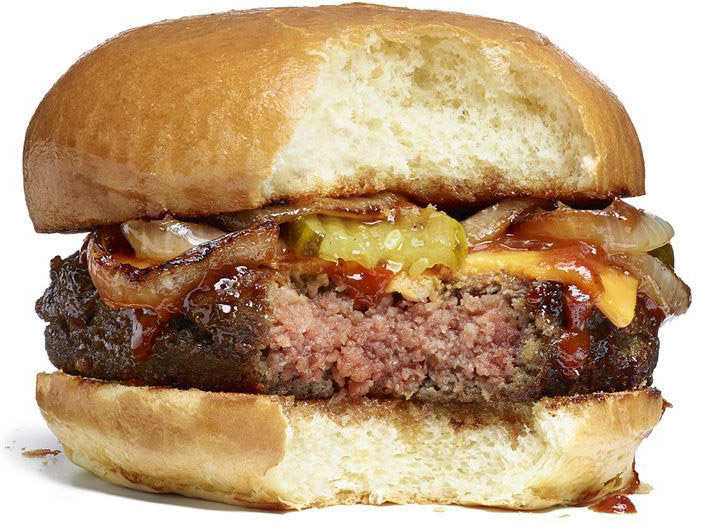
Impossible Foods’ meatless hamburger uses a manufactured “ground beef” that looks, cooks, and tastes like the real thing.
To the right is a photo of Dr. Brown’s meatless hamburger.
In terms of nutrition, the patty’s protein content may be slightly higher than that of a conventional burger and have at least as many micronutrients. Because it is made from plants, it will not contain any traces of antibiotics, hormones or cholesterol.
What do you think? Have you or would you eat them? Who do you think their market is? I’ll admit, they don’t appeal to me.
1Ingredients: Water, non-GMO soy protein isolate, pea protein isolate, amaranth, vegan chicken flavor (maltodextrin, yeast extract, salt, natural flavoring, sunflower oil), non-GMO expeller-pressed canola oil, non-GMO soy fiber, carrot fiber, contains 0.5% or less of: white vinegar, spices, salt, molasses powder, garlic extract, hickory smoke powder, onion extract, lemon juice concentrate, evaporated cane juice, dipotassium phosphate, titanium dioxide (for color), potassium chloride, paprika extract. (6 strips contain 5 grams fat, 3 grams carbohydrate, 20 grams protein, 120 calories.)







 Fanatic Cook