
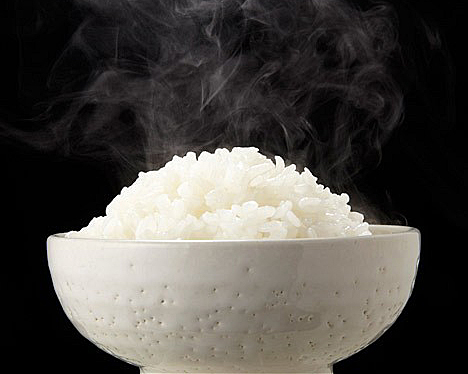
This photo accompanied the Telegraph article. While it’s beautiful, it somewhat misrepresents the research’s finding – that cooled rice contains fewer calories than hot rice. Although reheating rice after its cooled does not eliminate its resistant starch.
What happens to the starch in pasta, rice, potatoes, corn, oats, and many other starchy foods when you cook them, then allow them to cool slowly? The starch becomes resistant to our digestive enzymes. I’ve been writing about resistant starch (RS) for 10 years now so it’s probably familiar to you. Resistant starch passes through to the colon undigested and ends up feeding resident bacteria. We derive significantly fewer calories from starchy food that has been heated and cooled compared to just heated. We also derive benefit from the byproducts of the bacteria that eat the starch, e.g short-chain fatty acids and some vitamins. And, given the findings in this study, we may also derive cognitive benefit by populating our gut with beneficial RS-eating microorganisms.
Research presented at the American Chemical Society annual meeting last week described a technique for reducing calories in rice by up to 60%. You simply cook then cool the rice:
“The cooling is essential because amylose, the soluble part of the starch, leaves the granules during gelatinization,” explains [team leader Sudhair A. James]. “Cooling for 12 hours will lead to formation of hydrogen bonds between the amylose molecules outside the rice grains which also turns it into a resistant starch.” Reheating the rice for consumption, he notes, does not affect the RS levels.
Again:
RS is not broken down in the small intestine, where carbohydrates normally are metabolized into glucose and other simple sugars and absorbed into the bloodstream.
One more point. I say this often but it seems to go into the ether or something:
“After your body converts carbohydrates into glucose, any leftover fuel gets converted into a polysaccharide carbohydrate called glycogen,” [James] explains. “Your liver and muscles store glycogen for energy and quickly turn it back into glucose as needed.
People say that leftover glucose gets converted to fat. It doesn’t. It gets converted into glycogen, which is not fat.
Some headlines:
I wouldn’t call this technique “new,” would you?
New Low-Calorie Rice Could Help Cut Rising Obesity Rates, Press release from the American Chemical Society
This next title implies it’s more about the cooking. It’s not. It’s more about the cooling. By the way, this author says starch “has one central flaw: it isn’t that good for you.” The starch in potatoes, pumpkins, squashes, beans, peas, corn, carrots, barley, oats, wheat, and rice aren’t good for you. He also says that cooked potatoes are less healthful than raw potatoes. I don’t think I would ever eat a potato that wasn’t cooked:
Scientists Have Discovered A Simple Way To Cook Rice That Dramatically Cuts The Calories, Washington Post blog
Simple. Yes, it’s simple:
Simple Rice-Cooking Hack Could Reduce Calories By 60 Per Cent, The Telegraph
It’s true, eat it cold for fewer calories. But you can also reheat it if you don’t like it cold. Reheating won’t eliminate the resistant starch. In fact, the more you reheat and recool, the more resistant starch you create:
‘Eat Rice Cold For Fewer Calories’, BBC
 Fanatic Cook
Bix, you say:
‘One more point. I say this often but it seems to go into the ether or something:
“After your body converts carbohydrates into glucose, any leftover fuel gets converted into a polysaccharide carbohydrate called glycogen,” [James] explains. “Your liver and muscles store glycogen for energy and quickly turn it back into glucose as needed.
People say that leftover glucose gets converted to fat. It doesn’t. It gets converted into glycogen, which is not fat.’
Okay, but look at what James says right after the part you quote above:
“The issue is that the excess glucose that doesn’t get converted to glycogen ends up turning into fat, which can lead to excessive weight or obesity.”
LikeLike
That statement makes it appear as if eating carbohydrate makes us fat. It doesn’t.
The carbohydrate we eat has many fates. One fate, after energy production, a primary one that few disagree on is its replenishment of glycogen. That’s why I said it. A pound of glycogen stores about 1800 calories. We can store several pounds of glycogen in the body … liver, muscle, even fat cells store glycogen. We can store a lot of excess glucose as glycogen.
Fat production is not the primary fate of glucose after energy or glycogen production:*
What is the fate of excess glucose?
It can be spent in heat production:
Excess glucose can be consumed by gut bacteria:
Excess glucose has difficulty entering cells (for lipogenesis) if cells are insulin resistant. Cells become insulin resistant in a high-caloric/high dietary-fat environment, the dietary environment of many Americans. In such an environment, blood glucose rises, causing insulin to rise. Insulin is anabolic and supports lipogenesis. But the preferred substrate is fatty acids:
Excess glucose can be lost in the urine.
These are some of the mechanisms by which the body metabolizes or rids itself of excess glucose. These reactions are interwoven and complex, governed by many hormones, and unique to the individual.
Whole populations have survived and thrived on diets that got most of their calories from carbohydrates … rice, potatoes, corn, wheat, barley. And they did not not have the obesity problems we have today.
* Utilization Of Dietary Glucose In The Metabolic Syndrome, Nutrition and Metabolism, 2011
LikeLike