
The short answer is methionine, or lack of it. Vegan diets are devoid of animal protein which is high in the sulfur-containing amino acid methionine. And a lower methionine intake can spur the making of new mitochondria, where much fat oxidation (fat burning) takes place. Fat in muscle contributes to sarcopenia, so getting rid of it is good.
The long answer:
A High-Fat Diet Aggravates the Age-Related Decline in Skeletal Muscle Structure and Function, Exercise and Sports Sciences Reviews, October 2021
One thing I learned here is that the younger mice burned fat more readily than the older ones (so we shouldn’t generalize from studies that just use younger people):
Although in young-adult mice a high-fat diet (HFD) induced an increase in oxidative capacity that enhances the fatty acid oxidation capacity, this is not the case in muscles from old animals.
And a little diagram to show that:
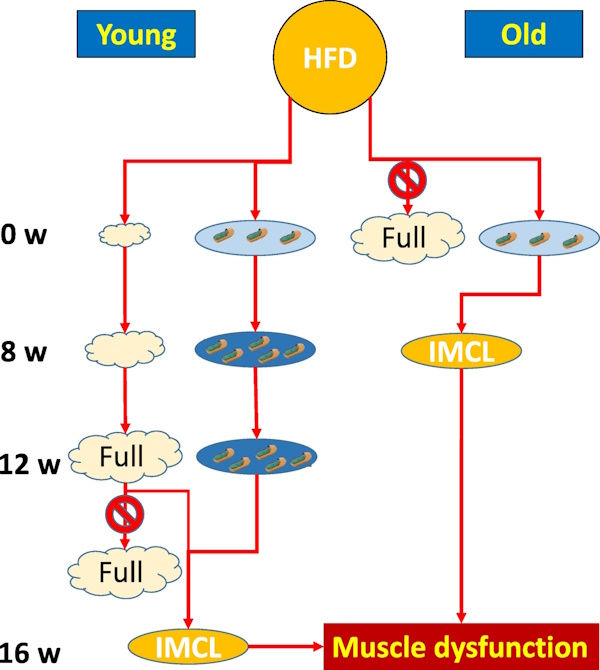
Figure: A high-fat diet (HFD) leads to an earlier accumulation of intramyocellular lipids (ICML) in muscles from old than young-adult mice. On the left hand side is the duration of HFD in weeks (w). The clouds illustrate the progressive increase in adiposity up to a point beyond which further lipid accumulation in adipose tissue is reduced. Here, we suggest that the larger adiposity in old than young mice limits the ability to store additional lipids in adipose tissue. In addition, whereas in young mice an HFD induced an increase in oxidative capacity, enhancing the ability to perform fatty acid oxidation, this was not the case in muscles from old animals. Thus, the higher need to store excessive lipids in muscle, as the adipose tissue is progressively filling up, and the lower ability to use fatty acids, as reflected by the absence of an HFD-induced rise in oxidative capacity in old muscles, results in an earlier accumulation of IMCL and muscle dysfunction in old than in young animals.
And so, ultimately, a high-fat diet became more detrimental as the mice aged:
Thus, the higher need to store excessive lipids in muscle and the lower ability to use fatty acids, as reflected by the absence of an HFD-induced rise in oxidative capacity, result in faster accumulation of intramyocellular lipids and muscle dysfunction in old than in young-adult animals.
By detrimental I’m referring to muscle mass loss (and muscle strength loss) or sarcopenia.
Sometimes people don’t know they’ve lost muscle because it was replaced by fat. They may be wearing the same size clothes but, for instance, climbing stairs becomes more difficult or they lose their balance easier. That’s sarcopenia.
During aging, the loss of muscle mass is accompanied by an increase in fat mass and body mass index (BMI).
It is clearly not a good idea to continue eating a high-fat diet as we age.
Overall, the evidence suggests that high-fat diet (HFD) consumption 1) exacerbates the age-related decline in muscle function and 2) that there is an age-related increase in susceptibility of HFD-induced IMCL accumulation and rise in body mass and BMI. Such a synergistic effect of aging and obesity is likely to contribute to poor health outcomes, reduced physical function, and poorer quality of life. Indeed, compared with normal-weight counterparts, sarcopenic obese people are at a greater risk of metabolic syndrome, cardiovascular disease, diabetes, and all-cause mortality (27).
How does eating a vegan diet (and reducing methionine) fit into all this? This is how:
1. Calorie restriction or dietary restriction attenuates sarcopenia.
2. Methionine restriction has been described as a calorie restriction mimetic and has been found to extend lifespan and reduce age-related inflammation in rats.
3. In practical terms, methionine restriction can be achieved by switching to a vegan diet as foods like fruits, vegetables, legumes, nuts, and soy contain relatively low quantities of methionine compared with animal products.
4. Although hyperphagia has been reported in mice on methionine restriction, it nevertheless induced a 30%–50% decrease in body mass and fat mass (35,38). This reduction in fat mass despite hyperphagia was related to an increase in energy expenditure and fat oxidation, and decreased insulin resistance (34,36). Part of this is attributable to a shift in fuel utilization to lipids as seen after 16 wk of methionine restriction in obese people (34).
5. In addition to stimulating mitochondrial biogenesis, methionine restriction has also been shown to reduce mitochondrial oxidative DNA damage.
Did you see what they said in number 4 above? Mice tended to overeat when methionine was restricted yet still they lost more weight, burned more fat and decreased insulin resistance relative to the non-methionine restrictors (the non-vegan eaters).
Vegan diets can stave off muscle loss (sarcopenia) as we age … because they restrict methionine.
To wrap up, here’s a little story about 53-year-old Vance who was on McDougall’s vegan diet for less than a year. I blogged about him here.

Vance’s before and after photos upon embarking on a vegan diet. Source: McDougall
In Vance’s words:
I was very surprised when I received my lab tests back from 6 weeks of eating the McDougall way. Although I was still obese, my cholesterol dropped by 120 points (from 230 to 110) and triglycerides from 340 to 135! Ridiculous! During my fitness days, when I only had 10% body fat, my cholesterol never dropped below 160. My blood pressure was now perfect too, and I never put the saltshaker down! … Four months later I was down 92 pounds! Even my testosterone went up from 170 to 600!
 Fanatic Cook
So interesting, thank you.
LikeLike