Category Archives: Diets

President-Elect Of American College of Cardiology Promotes Vegan Diet After Lowering His LDL From 170 To 90 In 6 Weeks

AmericanCollegeOfCardiologyDr. Kim Williams is a cardiologist and professor at Rush University in Chicago. He’s the incoming president of the American College of Cardiology. In the following article, the most-read cardiovascular article on MedPage Today for 2 weeks running, Williams explains why he is promoting a plant-based diet:

CardioBuzz: Vegan Diet, Healthy Heart?, MedPageToday, 21 July 2014

It was a patient’s success reversing an alarming condition that motivated me to investigate a vegan diet.

Just before the American College of Cardiology’s (ACC) annual meeting in 2003 I learned that my LDL cholesterol level was 170. It was clear that I needed to change something. Six months earlier, I had read a nuclear scan on a patient with very-high-risk findings — a severe three-vessel disease pattern of reversible ischemia.

The patient came back to the nuclear lab just before that 2003 ACC meeting. She had been following Dean Ornish, MD’s program for “Reversing Heart Disease,” which includes a plant-based diet, exercise, and meditation. She said that her chest pain had resolved in about 6 weeks, and her scan had become essentially normalized on this program.

When I got that LDL result, I looked up the details of the plant-based diet in Ornish’s publications — 1- and 5-year angiographic outcomes and marked improvement on PET perfusion scanning — small numbers of patients, but outcomes that reached statistical significance.

I thought I had a healthy diet — no red meat, no fried foods, little dairy, just chicken breast and fish. But a simple Web search informed me that my chicken-breast meals had more cholesterol content (84 mg/100 g) than pork (62 mg/100 g). So I changed that day to a cholesterol-free diet, using “meat substitutes” commonly available in stores and restaurants for protein. Within 6 weeks my LDL cholesterol level was down to 90.

Interestingly, our ACC/American Heart Association (AHA) prevention guidelines do not specifically recommend a vegan diet, as the studies are very large and observational or small and randomized, such as those on Ornish’s whole food, plant-based diet intervention reversing coronary artery stenosis. The data are very compelling, but larger randomized trials are needed to pass muster with our rigorous guideline methodology.

Wouldn’t it be a laudable goal of the American College of Cardiology to put ourselves out of business within a generation or two?

Look at what he was eating before he changed his diet, “no red meat, no fried foods, little dairy, just chicken breast and fish.” He thought that was healthy. Just about everyone I know thinks that’s healthy. Just about everyone I know has high cholesterol.

Dr. Williams is courageous coming out in favor of plant-based diets. Not only is he going against the profit-driven medical industrial complex (of which he is a part!) but there is a powerful meat-eating and meat-producing contingent in this country that will, I’m afraid, succeed in shutting down or at least marginalizing Williams’ message.

Dr. Dean Ornish is not as cynical as I am. He responded to Williams’ article with these encouraging words:

CardioBuzz: ‘Lifestyle Medicine’, MedPageToday, 31 July 2014

“The most influential trend in medicine today, growing exponentially, is the emerging field of what is known as “lifestyle medicine” — lifestyle as treatment, not just prevention. … We tend to think of advances in medicine as a new drug, laser, or surgical device, something high-tech and expensive. Yet, the simple choices we make in what we eat and how we live have a powerful influence on our health and well-being.”

He went on to summarize his research of the last 37 years – research that contributed to my belief that a whole food, plant-based diet is the way to go.

Before I end, I want to pass on this claim by Ornish that low-carb diets have yet to show good for primary outcomes:

“I am not aware of any study published in a peer-reviewed journal, even an uncontrolled study, showing that a high-fat, high-protein, low-carbohydrate diet can reverse the progression of coronary atherosclerosis or improve blood to the heart as measured directly using cardiac PET scans or even thallium scans.”

China Study: “Their High [Cholesterol] Was Our Low, And Their Low Was Off The Chart”

ChineseFarmer2

Wheat being harvested in China’s Jiangsu Province, October, 2011. China Bystander.

An excerpt from Dr. Campbell’s The China Study:

As I mentioned earlier, the range of blood cholesterol levels in rural China was a surprise. At the time when the China Study was begun, a blood cholesterol range of 200-300 milligrams per deciliter (mg/dl) was considered normal, and lower levels were suspect. In fact, some in the scientific and medical communities considered cholesterol levels lower than 150 mg/dl to be dangerous. In fact my own cholesterol was 260 mg/dl in the late 1970s, not unlike members of my immediate family. The doctor told me it was “fine, just average.”

But when we measured the blood cholesterol levels in China, we were shocked. They ranged from 70-170 mg/dl! Their high was our low, and their low was off the chart you might find in your doctor’s office! It became obvious that our idea of “normal” values (or ranges) only applies to Western subjects consuming the Western diet.

I was surprised when I read this a few years ago. I really did think a cholesterol of 200 was fine, good even. Now I think it’s high.

High-Fat Diet Linked To Loss Of Smell

OlfactoryNerveAccording to Dr. Perlmutter, author of the book Grain Brain, a high-fat diet should protect neurons from damage. In this new study, researchers show that a high-fat diet damages neurons, particularly those involved in the sense of smell:

Hyperlipidemic Diet Causes Loss of Olfactory Sensory Neurons, Reduces Olfactory Discrimination, and Disrupts Odor-Reversal Learning, Journal of Neuroscience, May 2014

We report marked loss of olfactory sensory neurons and their axonal projections after exposure to a fatty diet.

Mice maintained on fatty diets learn reward-reinforced behaviors more slowly, have deficits in reversal learning demonstrating behavioral inflexibility, and exhibit reduced olfactory discrimination

When obese mice are removed from their high-fat diet to regain normal body weight and fasting glucose, olfactory dysfunctions are retained.

New Research Links Bad Diet To Loss Of Smell, Florida State University Press release, 21 July 2014

The research was conducted over a six-month period where mice were given a high-fat daily diet, while also being taught to associate between a particular odor and a reward (water).

Mice that were fed the high-fat diets were slower to learn the association than the control population. And when researchers introduced a new odor to monitor their adjustment, the mice with the high-fat diets could not rapidly adapt, demonstrating reduced smell capabilities.

“Moreover, when high-fat-reared mice were placed on a diet of control chow during which they returned to normal body weight and blood chemistry, mice still had reduced olfactory capacities,” [lead author] Fadool said. “Mice exposed to high-fat diets only had 50 percent of the neurons that could operate to encode odor signals.”

It was the first time researchers had been able to demonstrate a solid link between a bad diet and a loss of smell.

An unfortunate part of this story is that once the mice returned to a regular low-fat diet and lost weight, they didn’t fully regain their sense of smell.

Some Thoughts On Dr. Perlmutter’s “Grain Brain”

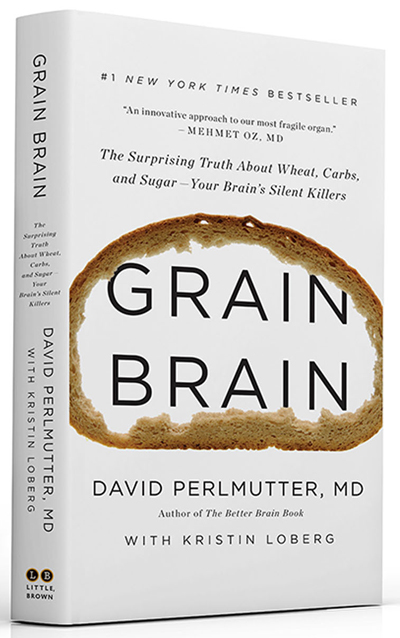
GrainBrainCover2I finally went to Amazon.com yesterday and skimmed through the book Grain Brain. The author, Dr. Perlmutter, is an award-winning, practicing neurologist. The book was a number one New York Times bestseller. Perhaps he has something to say.

Grain Brain: The Surprising Truth About Wheat, Carbs, and Sugar – Your Brain’s Silent Killers, by David Perlmutter and Kristin Loberg, September 2013

With “grain” in the title, I assumed the book was about avoiding gluten, a protein found in some grains. Was Perlmutter going to argue that gluten impacts neurological function? The full title, which I just saw now, is telling me it isn’t about gluten, not exclusively. It’s about carbohydrate.  So, is he arguing that dietary carbohydrate impacts neurological function? Any food with carbohydrate in it? Quinoa? Rice? Beans? Apples? Carrots? Lemons? Potatoes? Just about all plant foods contain carbohydrate.

Here’s what I found from Amazon’s “Look Inside”

Modern grains are silently destroying your brain. … I’m referring to all the grains that so many of us have embraced as being healthful – whole wheat, whole grain, multigrain, seven-grain, live grain, stone-ground, and so on.

I will demonstrate how fruit and other carbohydrates could be health hazards.

… An extremely low-carbohydrate but high-fat diet is ideal (we’re talking no more than 60 grams of carbs a day – the amount in a serving of fruit). This may also sound preposterous, but I’ll be recommending that you start swapping out your daily bread with butter and eggs. You’ll soon be consuming more saturated fat and cholesterol and re-thinking the aisles in your grocery store.

In the days leading up to your new way of eating, you’ll want to take an inventory of your kitchen and eliminate items that you’ll no longer be consuming. Start by removing the following … All forms of processed carbs, sugar and starch: corn, yams, potatoes, sweet potatoes.

The following can be used in moderation (“moderation” means eating small amounts of these ingredients once a day or, ideally, just a couple times weekly):
– Carrots and parsnips.
– Legumes (beans, lentils, peas).
– Non-gluten grains. (Avoid oats entirely.)
– Whole sweet fruit: Berries are best; be extra cautious of sugary fruits such as apricots, mangoes, melons, papaya, prunes, and pineapple.

I’m going to rescue you from a lifetime of trying to avoid eating fat and cholesterol and prove how these delicious ingredients preserve the highest functioning of your brain. … Our bodies thrive when given “good fats,” and cholesterol is one of these. And we don’t do so well with copious amounts of carbohydrates, even if those carbs are gluten-free, whole grain, and high in fiber.

Eating high-cholesterol foods has no impact on our actual cholesterol levels, and the alleged correlation between higher cholesterol and higher cardiac risk is absolute fallacy.1

You will be starting a daily supplement regimen for life. [Perlmutter sells supplements on his site.]

Yes, Perlmutter is saying that any intake of carbohydrate, beyond the 60 or so grams in a piece of fruit, impairs brain function. It’s evident that Dr. Perlmutter’s food journey and mine have led to drastically different diets. (At least he allows small amounts of beans. On a Paleo diet, you have to avoid them at all costs, even fresh green beans.)

Here’s a comment by srj, who claimed to be a physician. It’s representative of other comments which call into question Perlmutter’s treatment of the evidence:

“I quit reading about half way through the book because in almost every case he badly misinterpreted the studies he quoted. As an example, reference 25 in Chapter 4 (Title: Effects of Dietary Composition on Energy Expenditure During Weight-Loss Maintenance) compared people on a high glycemic diet, a low glycemic diet (whole grain) and a very low carbohydrate (high fat/meat) diet. This study did show a slight improvement in metabolic syndrome components in the low carb diet over the low glycemic diet, but the low carb diet raised cortisol and CRP (C-Reactive Protein) levels considerable. Previous studies have shown a 5-fold (that’s 500%!) increase in cardiovascular mortality with the higher levels of cortisol and CRP and thus the conclusion of the study authors was that the low carb diet was too dangerous to recommend. The only part of the study reported by Dr. Perlmutter was that that the metabolic syndrome parameters were better – nothing about the cortisol and CRP elevation which was far more important.”

I’m surprised at the assurance with which Perlmutter advances his ideas. Dr. David Katz, founding director of Yale University’s Prevention Research Center, criticized Grain Brain, saying many of its claims were “wildly preposterous,” particularly the one where Perlmutter says the ideal diet “is close to that of the Paleo diet: 75% fat, 20% protein, and 5% carbs.” Katz, citing work of researcher and “The Paleo Diet” author Lorin Cordain, said that humans during the Paleolithic Era ate mostly plants with a scattering of seeds and nuts. … “What the hell could they possibly have eaten that would be that fatty?”2

Maybe we’re all a little guilty of focusing on science that supports our preconceptions and glossing over that which challenges them. It’s our prerogative. Most of us aren’t writing books, selling products, and collecting consulting fees. Don’t you think that someone who is presenting himself as an authority, who claims to be science-based, who is urging millions of people to adopt a controversial diet, would be more even-handed with the evidence? I do. The reason I support eating a whole-food, plant-based diet is because I’ve read the studies, not because I’ve read a book by someone claiming to have read the studies for me.

_______
1 This particular claim has been exhaustively researched by a blogger who goes by Plant Positive. He refers to people who reject the lipid hypothesis, as Perlmutter does here, as cholesterol deniers. He’s amassed a trove of evidence that defends the lipid hypothesis, that defends the correlation between serum cholesterol and heart disease, i.e. the lower your cholesterol, the lower your heart disease risk.
2 James Hamblin’s skepticism is wholly transparent in his Atlantic article, “This Is Your Brain On Gluten.“)

Dr. Klaper: “Pouring Olive Oil On Food Does Not Suddenly Make It Heart-Healthy”

This is an excerpt from the presentation by Dr. Michael Klaper given at the Healthy Lifestyle Expo in 2012. He addresses olive oil, saying, “pouring olive on food does not suddenly make it heart-healthy.”

Highlights:

  • Restaurant food is “salt, sugar, and fat.” Eat before you go.
  • The Greeks have the highest rate of obesity in Europe.
  • Olive oil is 14% saturated fat.
  • “Remember, your body is never not looking.”
  • “Excessive saturated fats (even olive oil) stiffen the walls of the arteries and make them less responsive to nitric oxide which dilates the vessels and increases blood flow to the organs.”
  • How to stir fry without oil: Saute in seasoned vegetable broth.
  • For salad dressing without oil: Blend vegetables, fruits, nuts, vinegars, etc., puree and pour over greens.

Low-Carb, High-Fat Diets Linked To Poor Artery Function

AnginaPectoris

Angina pectoris is chest pain due to poor functioning of arteries supplying the heart.

The New York Times’ Mark Bittman and Time Magazine’s Bryan Walsh may be telling us to eat butter, suggesting that dietary fat is not a problem, carbohydrates are the problem. But researchers in Spain said there is a …

Negative effect of a low-carbohydrate, high-protein, high-fat diet on small peripheral artery reactivity in patients with increased cardiovascular risk, British Journal of Nutrition, April 2013 (pdf)

This was a cross-sectional analysis of 247 men and women.  Patients eating the least fat and the most carbohydrate (45% carb, 20% protein, 32% fat) had better small artery function than those eating the most fat and least carbohydrate (29% carb, 24% protein, 40% fat).

“Conclusion: In a cross-sectional study of patients with increased CV [cardiovascular disease] risk, a dietary pattern characterised by a high LCDS (high protein and fat, but low carbohydrate content) was associated with poorer peripheral small artery function compared with individuals consuming a diet with a lower LCDS. The association was strong in patients with two different metabolic diseases studied: the MS [Metabolic Syndrome] and T2D [Type 2 Diabetes].”

Dr. McDougall’s Picture Book

For the past year or so, I’ve been unabashedly endorsing a whole food, plant-based diet. After all these years and all these studies, I’ve come to believe it is the diet most health-promoting for most people. I’m often asked to describe it. What foods do you include, do you eliminate, do you sprinkle, do you shovel? Well, Dr. McDougall just published a very elementary picture book of his Starch Diet, one of the best versions of a plant-based diet out there. (Raw food diets, fruit diets, “vegan” diets, vegetarian diets, etc. are all types of plant-based diets, but each of them has drawbacks which I’ve discussed over the years.)

Not one to mince words, he calls it: “Dr. McDougall’s Color Picture Book: Food Poisoning And How To Cure It By Eating Beans, Corn, Pasta, Potatoes, And Rice.” (I’ve linked the entire 62-page book here in pdf format.)

In a nutshell, The McDougall Diet:

  • Is based on starches with vegetables and fruits.
  • Does not contain any animal foods or vegetable oils.
  • May contain some salt, sugar, and/or spice.

That’s it, seriously. Find foods you like that fit this description and eat them until your heart and stomach are content. No portion control, no counting calories. No kidding. The diet has been tested in randomized clinical trials of free living people and it works … it works for weight loss, diabetes prevention, heart disease prevention, arthritis management and prevention, and a slew of other chronic ailments, support for which you can find on my blog and of course on McDougall’s site. It works because it’s difficult to eat thousands of calories of low-fat, fiber-rich, health-promoting plant foods without feeling full.

Here are a few slides.  Beans soups are my mainstay:

McDougallPictureBook2

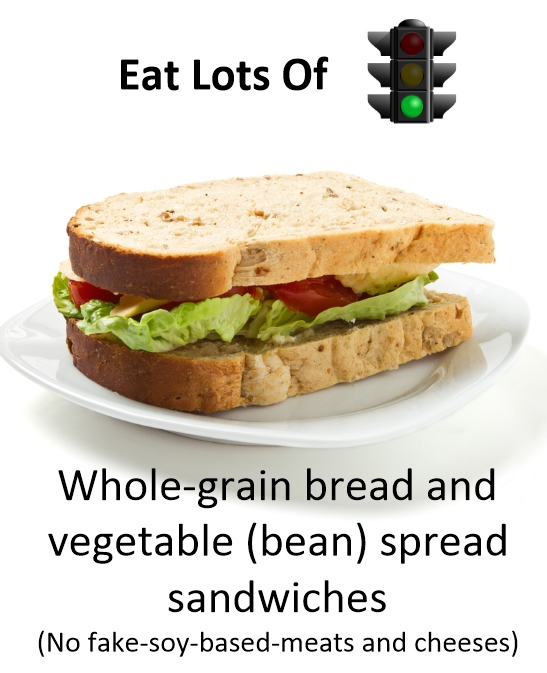
I just developed a wonderful fat-free hummus that I eat on sandwiches like this. You can buy fat-free hummus too:

McDougallPictureBook1

I was surprised at this, that he didn’t promote vegetables more. But since this post is turning out to be a testimonial, I’ll add that I’ve found this to be the case. I can eat a big bowl of steamed vegetables and feel absolutely stuffed but it disappears in several hours. On the plus side, eating lots of non-starchy vegetables is a great way to lose weight, if that’s your goal:

McDougallPictureBook3

High-Fat, High-Fructose Combination Worse Than High-Fat Or Low-Fat Alone

I’ve been saying this for years1,2 … a diet that is both high in fat and high in refined carbohydrates is worse (that is, leads to more metabolic disorders such as weight gain, diabetes, fatty liver, cancer) than a diet high in one or the other. The combination is particularly deleterious. (Although diets high in fat alone come with their own risks related to their higher levels of fat-soluble environmental toxins, increased systemic inflammation, and, as this study found, promotion of insulin resistance and fatty liver.)

This new study found that:

Fructose Supplementation Worsens The Deleterious Effects Of Short Term High Fat Feeding On Hepatic Steatosis And Lipid Metabolism In Adult Rats, Experimental Physiology, 27 June 2014

RatsHighFat2014Adult male rats were fed either a low-fat, high-fat, or high-fat/high fructose diet for 2 weeks. The high-fat/high-fructose diet was worse than the high-fat diet, which was worse than the low-fat diet. Another way of saying that … the low-fat diet was the healthiest.

Some significant bits:

“From our results, it appears that hepatic mitochondrial impairment is an early event induced by increased lipid content of the diet, since it is already evident after 2 weeks of dietary treatment, and that the presence of fructose does not have a further impact on mitochondrial function.

Significantly lower mitochondrial oxidative capacity but significantly higher oxidative stress was found in rats fed high fat and high fat-high fructose diet compared to rats fed low fat diet.”

During high fat feeding an increased lipid supply to peripheral organs, and particularly to the liver, arises mainly from dietary lipids.”

They say that mitochondrial impairment is linked to insulin resistance, and that it is dietary fat which initiates insulin resistance. It occurs because there is a reduced capacity by mitochondria to deal with the increased lipid supply. The extraneous fat is deposited ectopically or outside of the cell, leading to a fatty liver, which exacerbates insulin resistance. Adding fructose to this impaired state compounds the problem.

This is exactly what Dr. McDougall says happens. (Insulin Resistance Is A Normal Adaptation To A Rich Diet)

By the way, the rats fed a low-fat, high-carbohydrate diet (from cornstarch) by the end of the study weighed less, had less body fat, less liver fat, fewer plasma free fatty acids, and lower plasma cholesterol than the rats fed a high-fat diet, even though they ate the same amount of food (in calories) as the high-fat rats.

1 High-Fat High-Sugar Dietary Pattern (“Meat & Potatoes”) Linked To Colon Cancer, Diabetes, Fanatic Cook, July 2010
2 “Meat And Potatoes” Dietary Pattern And Risk For Colon Cancer, Fanatic Cook, May 2010